


What is 3D Fiberglass Woven Fabric?
Introduction
If you have ever searched for a lightweight, formable material that cuts down lamination steps for your projects, you may have come across terms like 3D fiberglass woven fabric, 3D spacer fabric, or three-dimensional woven fabric. Many new users find it confusing to tell these materials apart from ordinary layered fiberglass mats, and often struggle to understand how it works in real manufacturing. This article walks you through exactly what 3D Fiberglass Fabric is, how it is structured, its core advantages, and where it performs best, so you can decide whether it fits your next project without getting lost in overly technical jargon. As an experienced manufacturer in this field, Topweaving has built deep practical insights into this material through years of production and real-world application testing.
Key Takeaways
3D Fiberglass Woven Fabric is an integrated hollow-core sandwich structure, not a simple stack of flat fiberglass layers
It typically weighs 30% to 60% less than traditional layered fabrics at the same finished thickness
The one-step resin infusion process helps users save both working time and extra material costs
It supports easy shaping for angles, curves and complex forms without losing structural performance
The monolithic woven design greatly reduces the risk of delamination in final laminates
What Exactly Is 3D Fiberglass Woven Fabric?
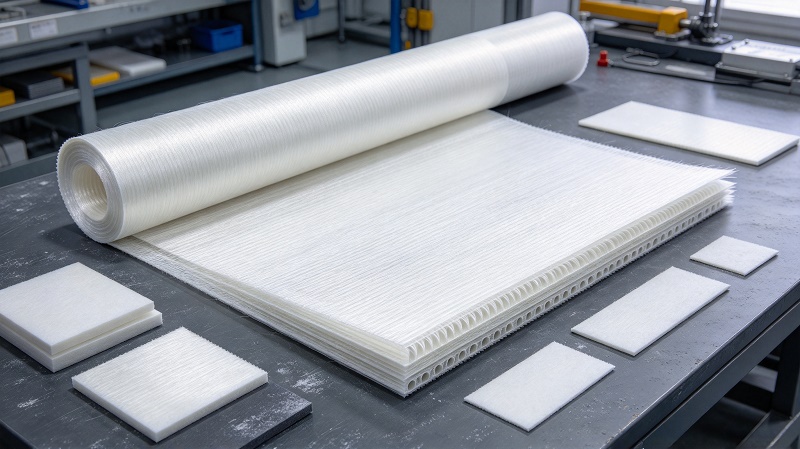
3D Fiberglass Fabric is a structural textile made from continuous E-glass yarns, produced through a specialized three-dimensional weaving process. Unlike regular 2D fiberglass cloth that only interlaces yarns on a single flat plane, this material weaves yarns not just across the surface, but also through the thickness direction. The final product forms two separate smooth surface layers connected by vertical fiberglass pile threads, creating one unified, hollow sandwich structure that cannot be easily separated into individual pieces.
Sometimes this material is also called 3D spacer fabric or three-dimensional woven fabric in different industry scenarios. What makes it different from ordinary fiberglass mats is that the core connecting piles are woven together with the top and bottom face layers in one single process, rather than being glued or assembled in a secondary step. This integrated design is the foundation of most of its unique performance advantages.
Core Performance and Practical Advantages
The biggest benefit users notice first when working with 3D Fiberglass Woven Fabric is its outstanding strength-to-weight ratio. Because of the built-in hollow core, the material delivers the same overall stiffness and thickness you would normally get from multiple layers of traditional fabrics, while being far lighter.
Another highly practical advantage is its simplified lamination workflow. When you apply thermoset resin like epoxy or vinylester onto the compressed fabric, capillary action pulls the resin evenly through the surface layers and the vertical connecting piles. Once you stop applying pressure, the fabric rebounds fully to its designed height, automatically forming a consistent hollow core inside. This one-step process removes many repeated layup steps that are required with conventional multi-layer materials.
It also performs extremely well when you need to create custom shapes. You can easily fold the material into sharp angles, gentle curves or complex forms directly inside your mold, and it will hold that shape reliably during the lamination process. There is no need for extra cutting, patching or bonding work that often creates weak points in finished parts.
Common Specifications Reference
| Typical Thickness Range | Weight Reduction vs. Equal Thickness Traditional Fabrics | Common Resin Compatibility |
|---|---|---|
| 3mm - 22mm | 30% to 60% lighter | Epoxy, Vinylester, Polyester |
Frequently Asked Questions
1. Is 3D Fiberglass Fabric the same as stacking several layers of regular fiberglass cloth?
No, it is a single integrated woven structure, not a simple stack of separate 2D layers.
2. Can I apply decorative laminates directly on this material?
Yes, you can laminate decorative layers on the mold side or roll them onto the wet fabric during processing.
3. Do I need special equipment to work with this material?
No, you can use standard resin infusion and rolling tools you already use for regular fiberglass work.
4. Can the final laminate get a smooth surface finish?
Yes, using a properly smooth waxed mold will help you get a clean, smooth surface on the finished part.
If you are looking for a more efficient, easy-to-process structural material for your next project, Topweaving 3D Fiberglass Woven Fabric delivers consistent performance and proven real-world usability across many application scenarios.