


Ultra-High-Molecular-Weight Polyethylene — better known as UHMWPE — has earned its nickname, the "21st-Century Super Fiber," through a combination of performance numbers that sound almost impossible: tensile strength up to 3.8 GPa, a density lighter than water, chemical resistance across pH 0–14, and a service life that can exceed a decade in the harshest environments on Earth — and beyond it. Whether you are sourcing material for ballistic protection, marine engineering, medical implants, or lightweight outdoor gear, understanding what UHMWPE material is — and specifically what woven UHMWPE fabriccan do that bulk UHMWPE plate or sheet cannot — is the starting point for every smart procurement decision.
This guide covers the chemistry, the key performance characteristics, a practical comparison against competing high-performance materials, a breakdown of real-world application sectors, and a concise FAQ that answers the questions buyers search for most. At the end, you will understand exactly why leading engineers on every continent choose Topweaving as their UHMWPE fabric supplier.
1. What Is UHMWPE Material?
UHMWPE is a thermoplastic polymer in the polyethylene family distinguished by its exceptionally long molecular chains, with molecular masses typically ranging from 3.5 to 7.5 million atomic mass units (amu). Those chain lengths are 10–20× longer than standard HDPE. When gel-spun into fibers and directionally crystallized, the aligned chains form covalent carbon–carbon bonds requiring approximately 335 kJ/mol to break — producing a material that is simultaneously ultra-light and extraordinarily strong.
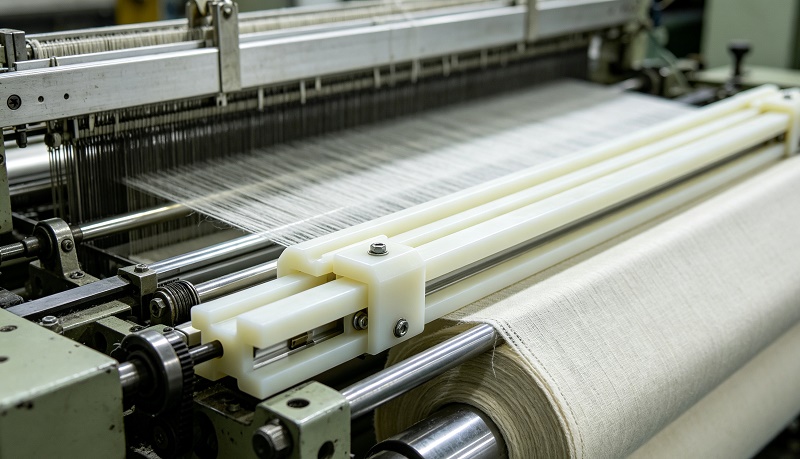
The fiber is then woven into UHMWPE fabric, the finished textile form that gives designers both the structural rigidity of the polymer and the geometrical flexibility of a woven architecture. This is where bulk UHMWPE (rods, sheets, plates) ends and where woven UHMWPE fabric begins: the fabric format enables composite laminates, tailored weight distributions, and the drapeability needed to conform to body armor curves, aerospace structural panels, and three-dimensional marine components.
2. Key Properties of UHMWPE Material
2.1 Extraordinary Strength-to-Weight Ratio
UHMWPE fiber achieves a specific strength 15× greater than steel and 40% higher than aramid (Kevlar) on a per-unit-weight basis. Topweaving's woven UHMWPE fabric reaches tensile strengths up to 3.8 GPa at areal weights as low as 7.5 g/m² — effectively delivering structural performance in what amounts to a layer of tissue paper. The fiber density sits at just 0.94–0.97 g/cm³, meaning it is one of the few engineering materials that float on water.
2.2 Unmatched Abrasion Resistance
Among all engineering plastics, UHMWPE posts the highest abrasion resistance: roughly 4× that of nylon and 7–10× that of carbon steel. The coefficient of friction ranges from 0.08 to 0.12 — approaching PTFE levels — and requires no external lubrication. The result is a fabric surface that resists progressive wear even under continuous high-load sliding contact, translating directly into longer product service lives on conveyor systems, mining chutes, and marine mooring components.
2.3 Broad Chemical and Environmental Resistance
UHMWPE is inert to virtually all acids, alkalis, and common organic solvents within the pH 0–14 range. The polymer does not absorb moisture, making it dimensionally stable in humid, marine, or wet-process environments. UV stability (nano-scale carbon black in Topweaving's black variants retains >95% performance after 5,000 hours of UV exposure) and a functional temperature window of −200 °C to +120 °C complete the environmental resistance profile.
2.4 Biocompatibility and Food Safety
Medical and food-contact grades of UHMWPE fabric pass ISO 10993 biocompatibility standards and FDA requirements. Zero heavy-metal precipitates and a cytotoxicity grade of 0–1 (per ISO 10993-5) make the material safe for direct skin contact, pharmaceutical packaging, and surgical implant components — a performance tier inaccessible to most other technical textiles.
2.5 Sustainability Credentials
UHMWPE is 100% recyclable, and Topweaving's production process consumes approximately 60% less energy than conventional PE manufacturing. The resulting carbon footprint is one-third that of standard polyethylene materials. GRS (Global Recycled Standard) certification is available on applicable product lines, supporting supply chains with ESG reporting obligations.
3. UHMWPE Fabric vs. Other High-Performance Materials
| Property | UHMWPE Fabric | Aramid / Kevlar® | Carbon Fiber Fabric |
|---|---|---|---|
| Density (g/cm³) | 0.94–0.97 | 1.44 | 1.75–1.80 |
| Tensile Strength | Up to 3.8 GPa | ~2.8 GPa | Up to 7 GPa (fiber) |
| Floats on water? | Yes | No | No |
| Chemical resistance | Excellent (pH 0–14) | Moderate (degrades in UV & moisture) | Good (matrix-dependent) |
| UV resistance | Excellent (stabilized grades) | Poor | Good |
| Biocompatibility | ISO 10993 / FDA certified | Limited | Depends on resin |
| Recyclability | 100% (GRS certified) | Difficult | Limited |
| Cost tier | Mid–Premium | Premium | High Premium |
The comparison underscores the key insight: UHMWPE fabric occupies a unique performance position — outperforming aramid on weight and UV stability, while rivaling carbon fiber in strength-to-weight ratio at a lower cost and with far superior chemical and impact resistance.
4. Types of UHMWPE Fabric: Weave Structures Explained
Not all UHMWPE fabric is the same. The weave architecture determines how load is distributed, how the fabric drapes or conforms to complex shapes, and how it performs in specific application environments.
Plain Weave
The most balanced construction — each warp fiber passes alternately over and under each weft fiber. Produces uniform tensile strength in both directions. Preferred for flat ballistic panels, conveyor belt overlays, and structural composite substrates.
Twill Weave
Characterized by a diagonal rib pattern, twill weave enhances drapeability for complex curves and molded components. Ideal for body armor that must conform to body contours, protective apparel, and composite aircraft panels with compound curves.
Leno Weave
A locking weave structure where warp yarns twist around weft yarns to prevent slippage. Provides superior dimensional stability in open, lightweight constructions. Frequently used in architectural mesh, filtration, and marine anti-fouling net applications.
3D-Structure Weave
Topweaving's proprietary three-dimensional weaving technology produces fabrics with integral depth — enabling hollow structures, Z-direction reinforcement, and custom cross-sectional profiles in a single weaving step. Used in aerospace structural panels, satellite components, deep-sea buoys, and medical implant frameworks where delamination resistance is non-negotiable.
5. UHMWPE Fabric Applications by Industry
Defense & Ballistic Protection
UHMWPE ballistic fabric is the backbone of modern lightweight armor. At 40% lighter than equivalent Kevlar® constructions, it enables bulletproof vests (NIJ Level II–IV compliant), military helmets with 25% greater coverage area, vehicle armor plates, and riot shields — all without sacrificing protection ratings. MIL-STD-6620 fragmentation resistance is achievable with properly engineered layup designs.
Marine & Offshore Engineering
In marine environments where saltwater corrosion destroys steel and biological fouling degrades conventional polymers, UHMWPE fabric thrives. Deep-sea mooring lines and cables up to 50 mm in diameter withstand loads exceeding 800 tons with a projected 30-year lifespan. Antimicrobial-coated UHMWPE nets reduce barnacle accumulation by up to 90%. Oil transfer hoses pass ASTM D543 chemical resistance standards.
Industrial & Mining
Conveyor belt overlays fabricated from UHMWPE fabric achieve a five-year operational life versus 1.5 years for conventional materials in high-abrasion mining environments. Industrial slings, protective machinery covers, and wear liners all benefit from the material's self-lubricating, friction-reducing surface.
Aerospace & Advanced Composites
UHMWPE fabric's outgassing behavior meets NASA standards, making it a viable structural material for satellite fairings, drone airframes reaching 320 MPa compressive strength, and lightweight antenna radomes where signal fidelity must be preserved.
Medical Devices
ISO 10993-certified UHMWPE fabric is used in joint replacement components (wear rate: 0.03 mm/year per ISO 14242-3), surgical sutures, and soft-tissue reinforcement implants. FDA 510(k) clearance pathways are supported by the material's documented biocompatibility profile.
Outdoor, Sports & PPE
Mountaineering ropes, cut-resistant gloves (EN 13594 Level 5), high-performance sailing gear, storm-proof tent fabrics (Category 10 wind resistance), and motorcycle protective clothing all leverage UHMWPE fabric's unique combination of lightness, cut resistance, and weatherproofing.
6. Frequently Asked Questions About UHMWPE Material
What exactly is UHMWPE material, and how is it different from regular polyethylene?
UHMWPE is polyethylene with molecular chains 10–20× longer than standard HDPE, reaching molecular weights of 3.5–7.5 million amu. Those longer chains create far denser intermolecular entanglement, translating into tensile strengths up to 3.8 GPa, abrasion resistance 4× greater than nylon, and a friction coefficient as low as 0.08 — performance tiers that conventional polyethylene cannot approach.
How does UHMWPE fabric compare to Kevlar (aramid)?
UHMWPE fabric is approximately 40% lighter than equivalent aramid constructions and offers 40% higher specific strength. It also outperforms aramid in UV stability (aramid degrades rapidly in sunlight), moisture resistance (aramid absorbs up to 3.5% moisture), and chemical resistance. Kevlar retains a slight advantage in high-temperature performance above 120 °C and in some cut-resistance configurations. For most modern body armor and structural applications, UHMWPE fabric is now the preferred choice.
Is UHMWPE the same as Dyneema or Spectra?
Dyneema® (DSM) and Spectra® (Honeywell) are brand names for UHMWPE fiber products. They use the same base polymer, produced through gel-spinning technology. Topweaving manufactures woven UHMWPE fabric using high-tenacity UHMWPE yarns and offers OEM/ODM customization — delivering comparable or superior woven performance without brand-name raw material premiums.
Is UHMWPE fabric waterproof?
UHMWPE fiber is inherently hydrophobic — it absorbs essentially zero moisture. Woven UHMWPE fabric in its uncoated form is highly water-repellent but not fully waterproof due to interstitial gaps between yarns. A laminated or coated finish (available from Topweaving) delivers full waterproofing for marine, outdoor, and medical barrier applications. The fiber itself is not degraded by prolonged immersion in seawater.
What temperature range can UHMWPE fabric withstand?
UHMWPE fabric performs reliably from −200 °C (cryogenic / polar environments) up to approximately +120 °C for continuous service, and short-term exposure slightly above that threshold. Above 130–135 °C the polymer begins to soften. For applications exceeding +150 °C, a hybrid UHMWPE/glass or UHMWPE/carbon construction is recommended.
Can UHMWPE fabric be customized — weight, weave, color, thickness?
Yes. Topweaving offers full customization: areal weights from 7.5 g/m² to 300+ g/m², thickness from 0.1 mm to 50 mm, plain / twill / leno / 3D weave structures, custom denier (50D–2000D), thread density (10–60 threads/cm), color options, and functional coatings (UV-stabilized, antimicrobial, laminated, antistatic). OEM/ODM development is supported with sample delivery within 48 hours and minimum orders from 100 m.
Is UHMWPE fabric environmentally sustainable?
UHMWPE is 100% recyclable, and Topweaving's manufacturing process uses approximately 60% less energy than conventional polyethylene production, resulting in a carbon footprint one-third that of standard PE. Product lines eligible for GRS (Global Recycled Standard) certification are available, supporting ESG compliance and green procurement requirements.
What certifications should I require from a UHMWPE fabric supplier?
At minimum, look for ISO 9001 (quality management), relevant application certifications (NIJ for ballistic fabric, ISO 10993 for medical-grade, OEKO-TEX for textiles in skin contact, ASTM D4884 for rope/sling material), and traceability documentation. Topweaving holds ISO 9001, ISO 14001, TUV supply chain certification, OEKO-TEX, NIJ (Level II–IV), ASTM D4884, ISO 10993, and GRS certifications — covering virtually every regulated application sector.
Why Choose Topweaving as Your UHMWPE Fabric Manufacturer?
Understanding UHMWPE material is only the first step. Finding a manufacturing partner who can translate those properties into consistent, certified, application-ready fabric at commercial scale is where projects succeed or stall.
Changzhou Topweaving New Material Technology Co., Ltd. has specialized exclusively in high-performance technical textiles since 2008. Our vertically integrated facility — from polymer purification through gel-spinning and 3D weaving to final coating and testing — controls every variable that determines whether a fabric delivers on its specification sheet in the field. With a monthly production capacity of 2 million square meters, TUV-certified supply chain processes, and a cross-disciplinary R&D team that invests 8.7% of annual revenue back into material innovation, Topweaving is not a trading company — we are the factory and the technical partner.
Every enquiry is supported by a dedicated applications engineer. Samples are dispatched within 48 hours. Bulk orders ship in 3–4 weeks. Whether your project demands a NIJ-certified ballistic panel, a GRS-marked sustainable fabric, a medical-grade ISO 10993 composite substrate, or a bespoke 3D-woven aerospace component, the solution starts with a conversation.
Contact Topweaving today at info@topweaving.com — and let our engineers turn the exceptional properties of UHMWPE material into your next competitive advantage.